Essential Oils for Hair Loss: Rosemary Evidence and Safe Options
Essential oils are reasonable to explore as an optional, carefully monitored scalp treatment for some adults with hair loss. Rosemary has limited but encouraging human research for pattern hair loss, and a diluted blend of thyme, rosemary, lavender, and cedarwood performed better than carrier oil alone in one controlled trial of alopecia areata.
Those findings are promising enough to take seriously—but not strong enough to promise regrowth or treat every kind of “baldness” with the same bottle. Pattern thinning, sudden shedding, smooth autoimmune patches, breakage, fungal infection, and scarring hair loss have different causes. The first useful step is identifying which problem is present; the second is choosing a method gentle enough not to create scalp inflammation that worsens the situation.
Quick answer
- Rosemary is the essential oil with the most relevant human evidence for gradual pattern hair loss. One randomized comparison found increased hair counts after six months with both rosemary-oil lotion and 2% minoxidil.
- A four-oil aromatherapy blend has one positive alopecia-areata trial. This is interesting adjunctive evidence, not a replacement for a dermatologist or current autoimmune treatments.
- Expect months, not days. Neither the rosemary group nor the minoxidil group in the 2015 study had a significant hair-count change at three months.
- Use a formulated product or a low dilution. Never pour neat rosemary, peppermint, thyme, cedarwood, lavender, or another essential oil onto the scalp.
- Photograph progress consistently. A monthly part-line or crown photo is more useful than trying to count every shed hair.
- Get a diagnosis for sudden, patchy, painful, inflamed, or scarring loss. Early care can matter when follicles are being damaged.
“Baldness” includes several different problems
Hair loss is medically called alopecia, but that umbrella covers many patterns:
- Androgenetic or pattern hair loss: gradual recession, crown thinning, a widening part, or reduced ponytail fullness related to genetic follicle sensitivity
- Telogen effluvium: increased shedding, often beginning a few months after childbirth, fever, illness, surgery, rapid weight loss, major stress, or a medicine change
- Alopecia areata: an autoimmune condition that often produces smooth round or oval patches and can also affect eyebrows, eyelashes, nails, or body hair
- Traction alopecia: loss from repeated pulling by tight braids, ponytails, extensions, locs, or other styles
- Scarring alopecia: inflammation destroys follicles and can make loss permanent; examples include central centrifugal cicatricial alopecia and frontal fibrosing alopecia
- Scalp disease: ringworm, psoriasis, seborrheic dermatitis, allergic dermatitis, and infection can cause shedding or breakage
- Hair-shaft breakage: chemical processing, heat, friction, and tight handling can shorten strands without hair releasing from the root
The American Academy of Dermatology emphasizes that the cause determines whether hair may regrow on its own, needs treatment, or requires prompt care to prevent permanent loss. An essential oil cannot sort those possibilities out.
Hair shedding is not always permanent hair loss
It is normal to shed roughly 50 to 100 hairs a day. Telogen effluvium means more follicles enter the resting and shedding phase at once. The increase often appears two or three months after a stressor rather than on the day it happens.
The AAD notes that postpartum or stress-related shedding often improves as the body readjusts, with fullness commonly returning over six to nine months. An oil used during that natural recovery can easily receive credit for hair that would have returned anyway.
Look at the strands and the pattern. Full-length hairs with a small pale bulb suggest shedding; many short, frayed pieces suggest breakage. A widening part or slowly enlarging crown suggests pattern loss. A smooth new patch suggests alopecia areata. These are starting clues, not a home diagnosis.
Why diagnosis should come before a long experiment
A dermatologist can examine the scalp and hair shafts with magnification, review timing and family history, perform a gentle pull test, and decide whether laboratory testing or a scalp biopsy is useful. Testing should be guided by the history rather than ordering every nutrient panel or “hormone balance” test.
Possible contributors include thyroid disease, iron deficiency, significant calorie or protein restriction, polycystic ovary syndrome, recent illness, autoimmune disease, medication effects, and scalp inflammation. Treating a genuine deficiency or disease is different from taking supplements “just in case.”
Early assessment is especially valuable for scarring alopecia. Once an inflamed follicle is destroyed and replaced by scar tissue, an oil cannot revive it. The goal becomes stopping progression while viable follicles remain.
What the rosemary study found
The widely cited 2015 rosemary-versus-minoxidil trial randomized 100 people with androgenetic alopecia to a rosemary-oil lotion or 2% minoxidil for six months. Standardized microphotographs showed no significant hair-count change in either group at three months. At six months, both groups had higher hair counts than at baseline, with no significant difference between them. Scalp itching increased in both groups but was reported more often with minoxidil.
This makes rosemary worth further study and reasonable for some adults to explore. It does not prove that rosemary is equal to every minoxidil product or that a few drops in shampoo reproduce the trial. Important limits include:
- only 50 participants received rosemary
- there was no untreated or vehicle-only placebo group
- the publication does not give consumers a simple essential-oil percentage they can reproduce safely
- 2% minoxidil is not the only or strongest evidence-based regimen now used for pattern loss
- the study does not establish results for alopecia areata, postpartum shedding, scarring alopecia, children, or damaged hair shafts
The most honest interpretation is “encouraging preliminary comparative evidence,” not “rosemary is proven to regrow anyone’s hair.”
Newer rosemary-blend research
A 2025 randomized, double-blind study compared two rosemary-containing commercial mixtures with coconut oil in 90 healthy adults over 90 days. The rosemary–lavender and rosemary–castor preparations showed larger changes in several hair-growth and density measurements than coconut oil.
This adds interest, but the tested products contained many ingredients—including carrier oils and additional botanicals—and participants did not necessarily have a single diagnosed form of alopecia. The trial cannot show which ingredient produced the effect, whether gains persist, or whether a homemade rosemary blend would behave the same way. Treat it as product-specific support for continued research rather than a universal recipe.
Option 1: explore a formulated rosemary scalp product
For an adult with gradual, non-scarring pattern thinning and a calm, intact scalp, a commercially formulated rosemary scalp product is the simplest essential-oil experiment. Choose one that discloses a complete ingredient list, provides scalp-use directions, has a batch or expiration marker, and does not promise a guaranteed cure.
Use this procedure:
- Establish the likely diagnosis first. Ask a dermatologist when the pattern is uncertain, changing quickly, or accompanied by symptoms.
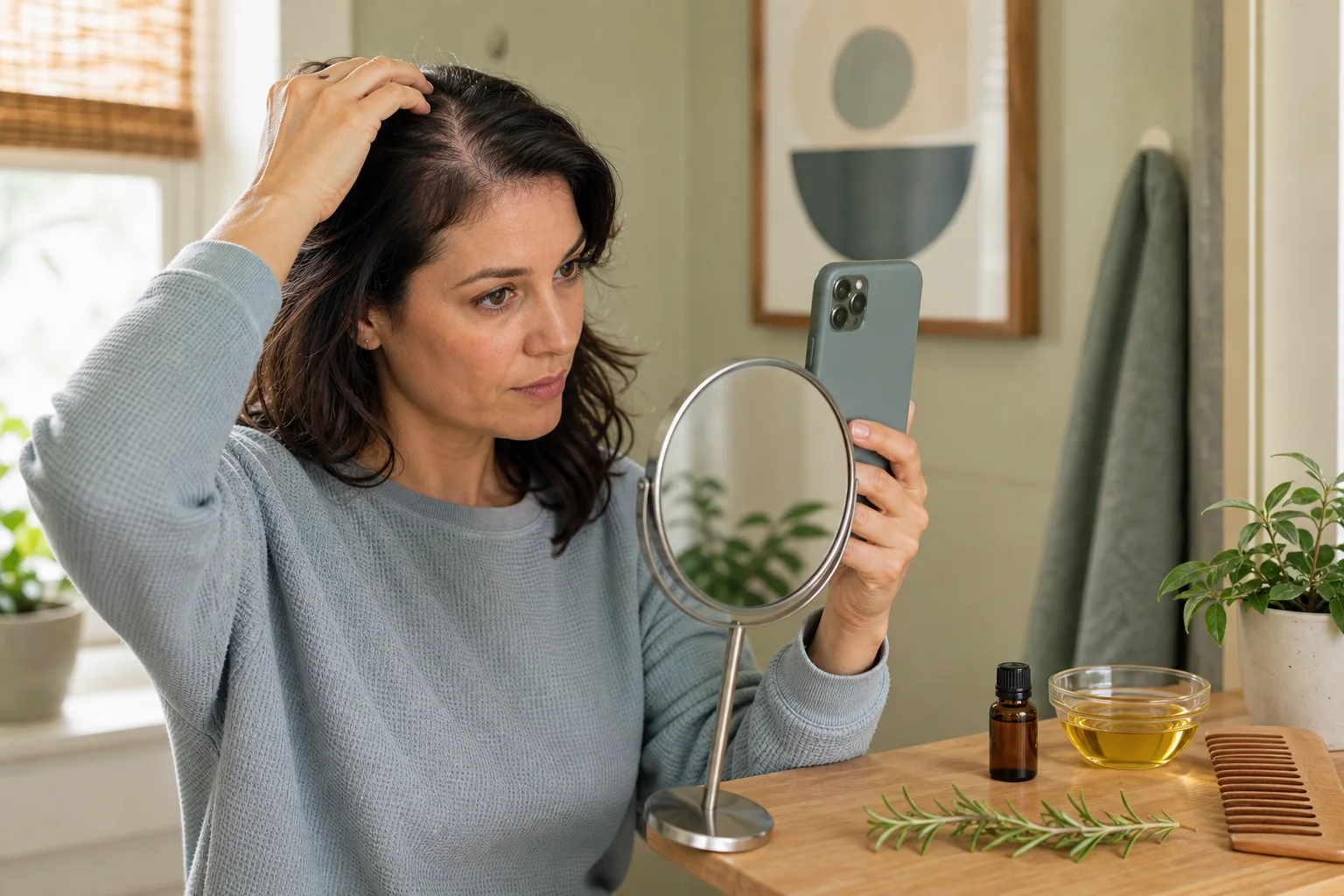
- Photograph a baseline. Use dry, unstyled hair, the same part, lighting, distance, and camera angle. Capture the front, both temples, part, and crown.
- Patch test the finished product. Apply a small labeled amount to a limited area behind the ear or on the inner arm. Check immediately and again over 48 hours for burning, itching, redness, bumps, or swelling.
- Follow the product—not social media. Use the labeled amount and frequency. Do not add extra essential oil to “strengthen” it.
- Keep other variables steady. Avoid starting three oils, supplements, and a new medicine at once. You will not know what helped or irritated you.
- Take monthly photographs. Do not expect a meaningful verdict at four weeks. The rosemary comparison did not show a significant count change at three months.
- Review at three and six months. Stop earlier for irritation or faster loss. If there is no benefit by six months, reconsider the plan with a dermatologist rather than increasing concentration.
Cosmetic products are not required to prove that they regrow hair before sale. Marketing language such as “follicle activating,” “DHT blocking,” or “clinically inspired” is not the same as a clinical endpoint.
Option 2: a conservative adult rosemary pre-wash oil
If you prefer a simple DIY trial, keep it lower in concentration than many internet recipes. This procedure is an exploration for a healthy adult with intact scalp skin; it is not the exact formulation used in the 2015 study.
For an approximate 1% dilution, combine:
- 1 fluid ounce (30 mL) jojoba or another plain carrier oil you already tolerate
- 6 total drops of rosemary essential oil
Cap, label, date, and store the mixture away from light and children. Drop size varies, so the percentage is approximate.
Patch test the finished blend for 48 hours. If there is no reaction, part the hair and massage a small amount across the target scalp—not the hair length—for about one minute. Start two or three times weekly as a 30- to 60-minute pre-shampoo treatment, then wash it out gently. More oil, harder massage, overnight occlusion, or daily escalation is not known to improve results.
Stop and wash the scalp if you develop burning, persistent itching, redness, flaking, bumps, headache, wheezing, or increased tenderness. Do not apply to broken, infected, sunburned, recently microneedled, or already inflamed skin.
The alopecia-areata aromatherapy trial
The most compelling multi-oil evidence applies to alopecia areata, not ordinary pattern baldness. In a seven-month randomized controlled trial published in 1998, 86 people with diagnosed alopecia areata performed daily scalp massage. The active group used thyme, rosemary, lavender, and cedarwood essential oils diluted in jojoba and grapeseed oils; the control group used the carrier oils alone.
Blinded photographic assessment found improvement in 19 of 43 people (44%) in the active group and 6 of 41 (15%) in the control group. The difference was statistically significant. That result is real and interesting, but most people in both groups were not classified as improved, the trial is old and small, and spontaneous regrowth is part of alopecia areata’s unpredictable course.
This study supports a conversation with a dermatologist about aromatherapy as an adjunct. It does not justify diagnosing a patch from a photograph, stopping corticosteroids, delaying treatment, or applying a strong homemade mix to a child.
A cautious way to explore the alopecia-areata evidence
If a dermatologist has confirmed localized alopecia areata and agrees that a topical botanical trial will not interfere with treatment, bring the original study citation to the appointment. Ask whether the scalp is intact, whether active prescriptions can be combined with an oil product, and how progression will be measured.
Rather than improvising the 1998 formula, consider having a pharmacist or appropriately qualified aromatherapy professional prepare a controlled, low-concentration product after reviewing allergies, seizure history, pregnancy, age, and current scalp medicines. Thyme oil is particularly easy to overconcentrate and irritate skin.
Continue the dermatologist’s monitoring. Current alopecia-areata care may include watchful waiting for a small recent patch, corticosteroids, minoxidil to help retain regrowth, contact immunotherapy, or a JAK inhibitor for more extensive disease. Aromatherapy should not displace a treatment chosen for the amount, duration, and location of loss.
Rosemary is not a substitute for minoxidil
Topical minoxidil has a much larger treatment history and is FDA-approved for pattern hair loss in men and women in specific formulations. It can slow loss and produce some regrowth, but it must be used consistently and benefits fade after stopping. Scalp irritation, unwanted facial hair, and an initial period of increased shedding can occur.
The 2015 comparison used 2% minoxidil and does not establish that rosemary equals 5% foam, other minoxidil schedules, or combinations prescribed by a dermatologist. AAD guidance for female pattern hair loss calls minoxidil the most-recommended treatment; AAD guidance for male pattern loss identifies topical minoxidil and prescription finasteride as FDA-approved options.
You do not have to choose “natural” or “medical” as competing identities. Some adults may use rosemary alone because they prefer it, while others may ask a dermatologist whether a rosemary product can coexist with a proven regimen. Do not layer products on your own when a label says not to use other scalp medicines.
Peppermint, lavender, cedarwood, and thyme
- Peppermint: A mouse study is often presented online as proof of human regrowth. It is not. Menthol can feel cool or tingly without activating dormant human follicles, and peppermint can irritate the scalp and eyes.
- Lavender: Lavender was part of the alopecia-areata blend and the newer multi-ingredient product study. Those results cannot isolate lavender’s contribution. Its aroma may make a routine pleasant enough to follow, but it is not a stand-alone proven regrowth treatment.
- Cedarwood: Cedarwood Atlas was included in the 1998 blend. Evidence for cedarwood alone is lacking.
- Thyme: Thyme was also in that trial, but many thyme oils are highly irritating when concentrated. It is a poor candidate for casual drop-count experimentation.
Rosemary is the clearest first oil to explore for gradual pattern thinning because it has a dedicated human comparison. Adding more oils increases the number of possible allergens without proving a better result.
Scalp safety matters to hair goals
Irritant or allergic contact dermatitis can cause itching, redness, scaling, and additional shedding or breakage. DermNet’s essential-oil allergy guidance warns against applying neat oils because repeated exposure can lead to sensitization.
Use fresh, properly stored oil; oxidation can increase allergenic breakdown products. Keep blends out of the eyes and off the face, wash hands after use, and do not cover the scalp with a plastic cap or heating device. Discontinue the entire blend rather than trying to “push through” a rash.
Do not use essential oils on the scalp immediately before or after microneedling. Microneedling changes the skin barrier and should be performed or directed by a qualified clinician when used for hair loss. A topical concentration tolerated on normal skin may be unsafe through freshly punctured skin.
Review the site’s Safe Use of Essential Oils before beginning any topical routine.
Children, pregnancy, breastfeeding, and pets
Do not use this article’s adult rosemary blend on a child. Patchy loss in a child could be alopecia areata, traction, hair pulling, or contagious scalp ringworm; each needs a different plan. Children can also transfer scalp oil to the eyes or mouth.
During pregnancy or breastfeeding, hair cycles change naturally and safety data for repeated medicinal essential-oil exposure are limited. Postpartum shedding usually has its own timeline. Ask a prenatal clinician and dermatologist before using concentrated scalp products. Minoxidil and prescription hair-loss medicines also have important pregnancy restrictions.
Store oils and scalp mixtures where children and pets cannot reach them. Do not swallow essential oils or take rosemary capsules for hair growth. Poison Control notes that essential oils can cause rashes, poisoning when swallowed, and lung injury if aspirated.
Supplements and “hormone-balancing” claims
Hair-loss marketing often pairs oils with biotin, zinc, iron, silica, collagen, or “hormone balance” supplements. More is not automatically better. Excess selenium, vitamin A, and other nutrients can contribute to hair loss or toxicity, while iron should generally be taken for a demonstrated need.
High-dose biotin can interfere with laboratory tests, including some tests used in emergencies; the FDA continues to warn about biotin interference. Tell clinicians and laboratory staff about every supplement you use.
Essential oils do not “balance hormones,” remove DHT from the body, cure thyroid disease, or correct anemia. A clinician can decide whether symptoms and history justify targeted testing.
Hair practices that protect what is present
Regardless of whether you try rosemary:
- loosen styles that cause pain, stinging, crusting, or tenting of the scalp
- limit repeated bleaching, relaxing, high heat, and aggressive brushing
- detangle gently, beginning at the ends
- choose a simple shampoo that does not leave the scalp inflamed
- condition hair lengths to reduce friction and breakage
- protect exposed scalp from sun with a hat or scalp-appropriate sunscreen
- eat enough calories and protein rather than pursuing restrictive “detox” diets
Carrier oil may reduce friction and make dry hair feel more flexible, but a strand that looks shinier is not evidence that its follicle has changed. Cosmetic improvement and biological regrowth are both valid goals; label them accurately.
How to measure whether an experiment is helping
Hair grows slowly, and memory is unreliable. Use a simple record:
- Take baseline photographs from four fixed angles with dry, product-free hair.
- Record the product, ingredient list, start date, amount, and schedule.
- Note scalp symptoms weekly on a 0-to-10 scale.
- Repeat photographs monthly under the same lighting and hair part.
- Assess at three months for tolerance and obvious worsening—not a final regrowth verdict.
- Assess at six months for visible density, part width, and dermatologist findings.
Stop sooner if loss accelerates, new patches appear, the hairline changes rapidly, or the scalp becomes sore, inflamed, or scaly. Do not respond by doubling the oil.
When to see a dermatologist promptly
Arrange an evaluation for:
- a smooth bald patch appearing over days or weeks
- loss of eyebrows, eyelashes, beard, or body hair
- pain, burning, tenderness, pus, crusting, sores, or significant itch
- a shiny area with fewer visible follicle openings
- loss spreading outward from the crown or accompanied by scalp symptoms
- broken hairs with scaling, especially in a child
- a rapidly receding frontal hairline or eyebrow loss
- shedding with fatigue, weight change, menstrual changes, or other systemic symptoms
- hair loss after a new medication or medical treatment
- distress that is affecting sleep, work, relationships, or self-esteem
A red, painful, infected, or inflamed scalp is not a place to test essential oils. Earlier diagnosis can preserve follicles in inflammatory and scarring conditions.
A practical decision guide
- Gradual family-pattern thinning, calm scalp: a formulated rosemary scalp product or conservative 1% adult pre-wash blend is reasonable to explore while considering established options.
- Smooth round patches: see a dermatologist for possible alopecia areata; discuss the four-oil trial only after diagnosis.
- Diffuse shedding after illness, surgery, birth, or major stress: identify and address the trigger; oils may support a pleasant routine but may not change the natural recovery timeline.
- Hair snapping along the shaft: focus on gentler styling, heat, chemicals, and conditioning rather than follicle stimulants.
- Pain, burning, scale, pustules, or shiny scarring: stop scalp experiments and seek care promptly.
- Child, pregnancy, breastfeeding, or complex medical history: obtain individualized guidance before a medicated or concentrated topical product.
For gentler aromatherapy context, see the Lavender Essential Oil profile.
Bottom line
It is fair to be cautiously hopeful about rosemary. Human research gives it more credibility than many hair-growth oils, and the alopecia-areata blend is a legitimate signal that deserves better replication. A six-month, low-irritation, photographed experiment can be a reasonable choice for an informed adult with the right kind of hair loss.
The procedure matters as much as the ingredient: establish the likely diagnosis, use a finished product or low dilution, change one variable at a time, protect the scalp barrier, and stop for irritation or progression. Essential oils should expand the range of thoughtful options—not blur distinct diagnoses or delay care while follicles are still recoverable.
Sources
- American Academy of Dermatology. Hair loss: Who gets and causes. Accessed August 3, 2026.
- American Academy of Dermatology. Do you have hair loss or hair shedding?. Accessed August 3, 2026.
- American Academy of Dermatology. Alopecia areata: Diagnosis and treatment. Accessed August 3, 2026.
- Panahi Y, Taghizadeh M, Marzony ET, Sahebkar A. Rosemary oil vs minoxidil 2% for the treatment of androgenetic alopecia. Skinmed. 2015;13(1):15–21.
- Hay IC, Jamieson M, Ormerod AD. Randomized Trial of Aromatherapy: Successful Treatment for Alopecia Areata. Archives of Dermatology. 1998;134(11):1349–1352.
- Patel N, et al. Rosmagain as a Natural Therapeutic for Hair Regrowth and Scalp Health. Cureus. 2025;17(6):e85906.
- American Academy of Dermatology. Female pattern hair loss. Accessed August 3, 2026.
- American Academy of Dermatology. Male pattern hair loss treatment. Accessed August 3, 2026.
- DermNet New Zealand. Allergic contact dermatitis to essential oils. January 2020.
- U.S. Food and Drug Administration. Biotin Interference with Troponin Lab Tests. Accessed August 3, 2026.
- National Capital Poison Center. Essential oils: Poisonous when misused. Accessed August 3, 2026.
This article is for education and does not diagnose hair loss or guarantee regrowth. Essential oils are optional supportive scalp-care approaches, not substitutes for diagnosis or treatment of autoimmune, infectious, nutritional, hormonal, or scarring conditions.