
Essential Oils for a Sore Throat: Comfort Options and Safe Use
A sore throat is often part of a short-lived viral illness, and essential oils can be explored as an optional comfort measure—not as a cure. The most defensible options are a professionally formulated throat product used exactly as labeled or brief, low-intensity aroma use. These approaches may make the throat feel cooler, the surrounding air feel fresher, or a rest routine more comfortable.
The limits matter. Essential oils have not been shown to clear strep throat, replace antibiotics when strep is confirmed, or prevent complications. Do not gargle or swallow bottled essential oils, add them to water or tea, or place them directly on the tonsils. A concentrated oil can irritate already inflamed tissue, and oil does not disperse safely in water.
Quick guide: when exploration is reasonable
It may be reasonable for an adult with a mild sore throat, normal breathing, and the ability to drink fluids to try a conservative essential-oil option alongside ordinary self-care. A good experiment has three features:
- it is intended for the route being used—for example, a labeled oral spray rather than a homemade mixture
- it starts with the lowest practical exposure and stops if it burns, triggers coughing, worsens asthma, causes headache, or irritates skin
- it is judged only by comfort, not by whether it “kills germs” or makes an infection safe to ignore
Seek medical advice instead of escalating aromatherapy if pain is severe, symptoms are worsening, swallowing is difficult, strep is possible, or the person is very young, pregnant, immunocompromised, or medically fragile.
What causes a sore throat?
“Sore throat” describes a symptom, not one diagnosis. Viruses that cause colds and flu are the most common cause. Postnasal drip, allergies, dry air, smoke, reflux, voice strain, COVID-19, and other infections can also inflame or irritate the throat. Less often, a bacterial infection such as group A strep is responsible.
According to the CDC’s sore-throat guidance, most sore throats improve on their own within about a week. Cough, runny nose, hoarseness, or conjunctivitis tend to point toward a viral cause, but symptoms alone are not always enough to identify the cause.
Could it be strep throat?
Strep is more common in children ages 5 to 15 than in adults. A sudden sore throat, fever, painful swallowing, tender glands at the front of the neck, red or enlarged tonsils, white tonsil patches, or a rough red rash can raise suspicion. The absence of cough and runny nose also makes strep more plausible—but looking at the throat cannot confirm it.
When clear viral symptoms are absent, the CDC’s clinical guidance for group A strep recommends testing with a rapid antigen test or throat culture. A positive test needs appropriate antibiotics. Treatment shortens symptoms, reduces spread, and lowers the risk of complications. In symptomatic children age 3 or older, a negative rapid test should generally be backed up with a throat culture.
Essential oils should not be used to “test” whether the illness is strep and should never delay a swab or prescribed antibiotic.
What the essential-oil research actually shows
Direct clinical evidence is small, old, and product-specific. In a randomized double-blind trial of 60 adults with upper-respiratory infections, a throat spray containing emulsified essential oils of two eucalyptus species, peppermint, Syrian oregano, and rosemary produced more short-term improvement in the participants’ most troublesome symptom—sore throat, hoarseness, or cough—than a placebo spray at 20 minutes. After three days, the groups were not significantly different. Mild dry-throat or stinging effects occurred in both groups.
The full trial report is interesting because it supports a possibility of temporary local comfort. It does not show that the spray treated an infection, shortened the illness, worked specifically for strep, or validated putting retail essential oils in the mouth. The tested product used a measured, professionally emulsified formulation; oil and water shaken together is not equivalent.
A later rapid review of essential oils for viral respiratory infections judged the two upper-respiratory trials to show little clinical efficacy over the course of illness and found no clinical research establishing inhaled essential oils for acute viral respiratory infections. That leaves room to explore sensory comfort, but not to promise disease treatment.
Which essential oils are reasonable to explore?
No single oil is proven to treat a sore throat. These choices are best understood by the experience they may offer:
- Lavender: a softer aroma for a quiet rest routine. It was not part of the throat-spray trial, and there is no good evidence that it treats throat inflammation or infection.
- Eucalyptus: a strong, fresh aroma that some adults find easier to breathe around when congested. Eucalyptus species were included in the trial, but the result applies to the complete spray—not to homemade eucalyptus preparations. Swallowed eucalyptus oil can cause seizures.
- Peppermint: menthol creates a cooling sensation and can make airflow feel more noticeable. That sensation does not prove the airway is more open. NCCIH’s peppermint-oil review says evidence is insufficient for most uses and warns against applying peppermint near the face of infants or young children.
- Multi-oil commercial throat products: these most closely resemble the limited human evidence, provided the product is specifically labeled for oral or throat use and is appropriate for the user’s age and health.
Oregano, thyme, cinnamon bark, clove, and some “protective” blends are especially irritating when concentrated. Their laboratory antimicrobial activity is not evidence that a DIY gargle safely treats a human throat infection.
Option 1: try a properly formulated throat product
For an adult who wants the most evidence-matched experiment, a commercially manufactured spray or lozenge specifically labeled for mouth or throat use is more defensible than a bottle-to-glass recipe.
- Read the active ingredients, age limits, warnings, alcohol content, and dosing directions.
- Confirm that the label explicitly permits use in the mouth or throat. “Food grade,” “therapeutic grade,” or a supplement label alone is not enough.
- Avoid the product if you are allergic to an ingredient or if its warning conflicts with pregnancy, medication, asthma, reflux, or another condition.
- Use one labeled dose—never add extra bottled essential oil.
- Note comfort before use and again after about 20 to 30 minutes.
- Stop if it causes burning, wheezing, persistent coughing, swelling, numbness that interferes with swallowing, or worsening pain.
- Do not exceed the label or use symptom relief as a reason to postpone strep testing or medical care.
This is an exploration of short-term comfort. A product that feels soothing has not necessarily changed the cause or contagiousness of the illness.
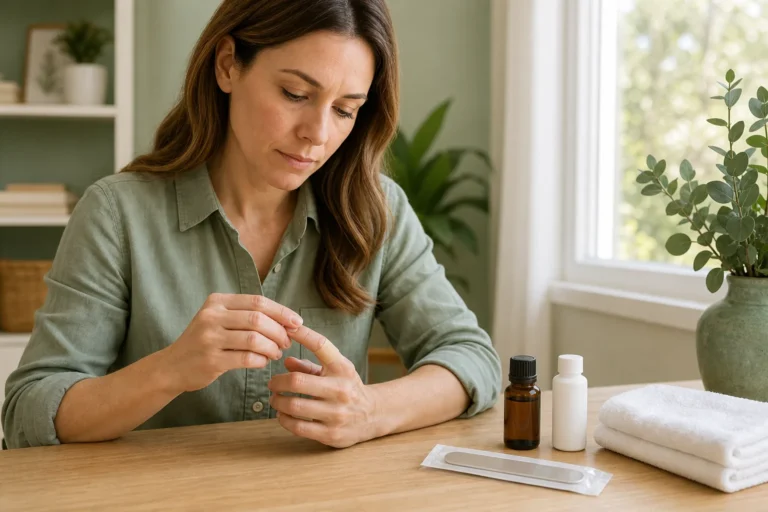
Option 2: use a personal aroma strip
Personal aroma use avoids putting oil on inflamed throat tissue and lets the user control exposure.
- Place one drop of lavender or eucalyptus essential oil on a paper aroma strip or plain tissue.
- Set it at arm’s length for a minute rather than immediately holding it under the nose.
- If the aroma is comfortable, take two or three normal, gentle breaths. Do not inhale forcefully.
- Put the strip aside and reassess. More aroma is not necessarily more helpful.
- Discard it where children and pets cannot reach it, then wash your hands.
Do not insert the strip into a nostril, touch it to the lips, sleep with it against the face, or use this method during wheezing or breathing difficulty. If scent tends to trigger migraine, nausea, cough, or asthma, choose non-aromatic comfort measures instead.
Option 3: a low-dilution adult chest or shoulder rub
Some adults enjoy a diluted aromatic rub as part of a rest routine, especially when a sore throat occurs with mild congestion. This has not been shown to treat throat pain or infection, so keep the goal modest.
For an approximate 1% adult dilution, mix six total drops of essential oil into 1 fluid ounce (30 mL) of a plain carrier oil. One gentle blend is four drops of lavender plus two drops of eucalyptus. Drop size varies, so this is an approximation, not a medical dose.
Before wider use, apply a small amount of the finished dilution to a limited area of intact forearm skin and wait 24 hours. If there is no irritation, rub a small amount onto the upper chest or shoulders once or twice during the day. Keep it away from the front of the neck, face, broken skin, heating pads, tight bandages, and irritated tissue. Wash it off and stop if burning, rash, headache, nausea, or breathing symptoms develop.
This recipe is for healthy adults, not children, pregnancy, breastfeeding, frail older adults, or people with seizure disorders, serious lung disease, multiple allergies, or complex medication regimens without individualized professional advice.
What about a room diffuser?
A brief diffuser session may make a rest space feel more pleasant, but it is less controllable than a personal aroma strip and has no demonstrated effect on the duration of a sore throat.
Use only the amount and water volume specified by the diffuser manufacturer, choose the lowest output, run it for about 15 minutes in a ventilated room, and then turn it off. Anyone who dislikes the scent should be able to leave. Do not run a diffuser continuously, place it beside the face, or add oil to a plain humidifier unless that device is explicitly designed for it.
Avoid shared-room diffusion around infants, young children, birds, and pets with respiratory disease. Ask a veterinarian about species-specific risk before diffusing around pets.
Do not gargle, swallow, or nebulize essential oils
Essential oils do not dissolve in water. Drops added to water, tea, honey, or saltwater can remain concentrated and contact the mouth, throat, or esophagus directly. Oregano, cinnamon, clove, thyme, peppermint, eucalyptus, and blended oils can cause burning, coughing, nausea, allergic reactions, or poisoning.
Poison Control’s essential-oil guidance notes that swallowed oils can be toxic and that aspiration—oil entering the lungs during choking or vomiting—can cause pneumonia. Eucalyptus oil can cause seizures when swallowed. Do not rely on a “food grade” label to make a home dose safe.
Also avoid nebulizers, essential-oil vaping, boiling-water steam tents, and drops placed in a medical humidifier or CPAP device. If oil is swallowed, do not induce vomiting; contact Poison Control in the United States at 1-800-222-1222 or use webPOISONCONTROL, and call emergency services for breathing trouble, seizure, collapse, or severe symptoms.
Better-supported sore-throat comfort measures
Essential-oil exploration should sit beside—not replace—simple measures with broader support:
- drink cool or warm fluids, whichever feels better
- use ice chips, frozen pops, or age-appropriate lozenges
- gargle warm saltwater if old enough to gargle and spit reliably; MedlinePlus suggests about 1/2 teaspoon (3 grams) of salt in a glass of warm water
- use a clean cool-mist humidifier
- avoid smoke and vaping
- use honey for cough in adults and children at least 1 year old; never give honey to an infant
- ask a clinician or pharmacist about acetaminophen, ibuprofen, medicated lozenges, or sprays that are appropriate for age, pregnancy, medical conditions, and current medicines
Children should never receive aspirin for a viral illness. Lozenges are a choking hazard for young children, and over-the-counter cough and cold products have age limits.
Children need a different plan
Do not use the adult throat-product, aroma-strip, chest-rub, or diffuser procedures as child dosing instructions. Children are more vulnerable to accidental swallowing, breathing reactions, and concentrated skin exposure. Peppermint or menthol should not be applied near an infant’s or young child’s face, and bottled oils should be locked away.
For a child with a sore throat, focus on fluids, age-appropriate foods and comfort, a clean cool-mist humidifier, and medicines specifically approved by the child’s clinician or label. Honey is only for children at least 1 year old. Arrange medical advice for possible strep, a sore throat lasting more than a few days, worsening illness, or any concern about drinking and hydration.
A baby younger than 3 months with a temperature of 100.4°F (38°C) or higher needs prompt medical advice. Breathing trouble, drooling, inability to swallow, blue or gray color, severe sleepiness, or dehydration is urgent at any age.
Pregnancy, asthma, reflux, allergies, and medications
Pregnancy and breastfeeding change the safety calculation because evidence for medicinal essential-oil exposure is limited. A pleasant smell in ordinary surroundings is different from repeated concentrated use. Discuss a throat product, topical blend, or regular diffusion with a prenatal clinician before trying it.
People with asthma or scent-triggered breathing symptoms should avoid aromatherapy during a flare and stop immediately if an aroma causes chest tightness, wheezing, or coughing. Peppermint may aggravate reflux in some people, and reflux itself can cause persistent throat irritation. Skin allergy can develop even after prior uneventful use.
If you take anticoagulants, seizure medicines, sedatives, or several prescription drugs—or have liver, kidney, neurologic, or respiratory disease—ask a pharmacist or clinician to review the exact product and route. “Natural” does not rule out an interaction.
When to seek urgent or emergency care
Call emergency services for severe breathing difficulty, blue or gray lips, collapse, confusion, or signs of a severe allergic reaction. Seek urgent in-person care for:
- noisy or high-pitched breathing
- inability to swallow saliva, new drooling, or rapidly worsening swallowing difficulty
- a muffled “hot potato” voice, inability to open the mouth normally, marked one-sided throat pain, or visible neck swelling
- dehydration, very little urine, dizziness, or inability to keep fluids down
- blood in saliva or phlegm
- severe weakness, a spreading rash, stiff neck, or rapidly worsening illness
These can signal airway swelling, a deep infection, an abscess, or another problem that aromatherapy cannot safely address.
When to contact a clinician soon
Arrange medical advice when strep is possible, fever is persistent, symptoms worsen after initial improvement, pain is severe, or the sore throat is not improving within a few days. Also seek evaluation for repeated sore throats, a persistent lump or one-sided symptom, unexplained weight loss, immune suppression, recent chemotherapy, or a sore throat lasting longer than expected.
If strep testing is positive, take the antibiotic exactly as prescribed even if a spray, lozenge, or aroma makes the throat feel better. Ask when it is safe to return to school or work; CDC guidance generally requires being fever-free and at least 12 to 24 hours into appropriate antibiotics.
A practical decision guide
- Mild, likely viral symptoms; breathing and drinking are normal: use fluids, saltwater, humidification, and age-appropriate pain relief. An adult may also try one conservative essential-oil comfort option.
- Short-term aroma comfort is the goal: start with a one-drop aroma strip. It is easy to stop and does not contact the throat.
- Direct throat comfort is the goal: choose only a professionally formulated, age-appropriate product labeled for oral or throat use; follow its directions exactly.
- Strep seems possible: arrange testing. Do not use symptom improvement to rule strep out.
- Symptoms are severe, unusual, or worsening: skip aromatherapy and obtain medical care.
For related guidance, see Essential Oils for Congestion, the site’s Safe Use of Essential Oils, and the detailed Eucalyptus Essential Oil profile.
Bottom line
There is a reasonable middle path between promising too much and refusing to explore. A properly formulated throat product may provide brief relief, and a low-intensity aroma routine may make rest more comfortable for some adults. Those are worthwhile outcomes if expectations stay honest and the method stays conservative.
Essential oils do not diagnose the cause, cure strep, or replace established care. Keep bottled oils out of the mouth, use the least exposure that accomplishes the comfort goal, and let breathing, swallowing, hydration, illness severity, and the need for testing determine when to move from home care to professional care.
Sources
- Centers for Disease Control and Prevention. Sore Throat Basics. Updated April 17, 2024.
- Centers for Disease Control and Prevention. Clinical Guidance for Group A Streptococcal Pharyngitis. Updated November 18, 2025.
- Ben-Arye E, et al. Treatment of Upper Respiratory Tract Infections in Primary Care: A Randomized Study Using Aromatic Herbs. Evidence-Based Complementary and Alternative Medicine. 2011.
- Prall S, et al. Effects of essential oils on symptoms and course of viral respiratory infections in humans: A rapid review. Advances in Integrative Medicine. 2020.
- National Center for Complementary and Integrative Health. Peppermint Oil: Usefulness and Safety.
- MedlinePlus. Pharyngitis—viral. Reviewed February 1, 2025.
- National Capital Poison Center. Essential oils: Poisonous when misused. Accessed August 3, 2026.
This article is for education and does not diagnose or treat illness. Essential oils are optional supportive comfort measures, not substitutes for testing, antibiotics when indicated, or individualized medical care.